Key takeaways
- 304 (18/8) is the default food-contact grade for cookware interiors; 18/10 is 304 with more nickel for a brighter, more corrosion-resistant finish.
- 201 replaces part of the nickel with manganese. It costs less but pits and stains faster in salty or acidic use.
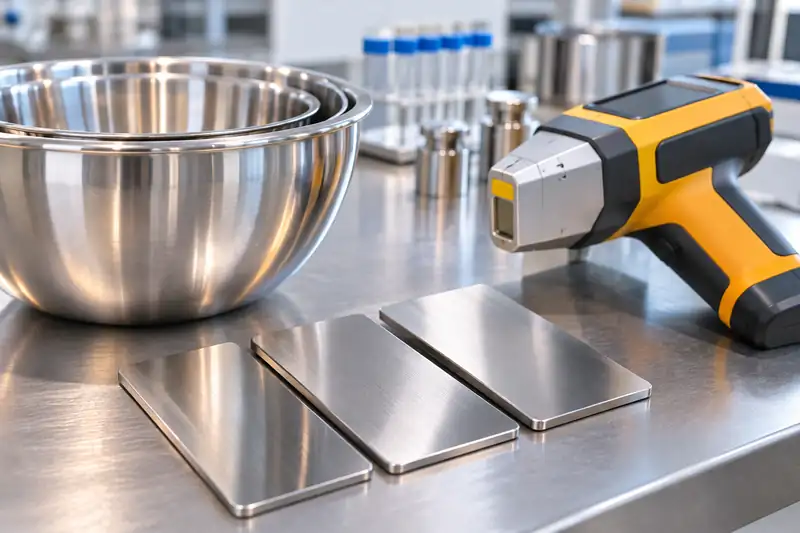
- Magnetism is not a reliable grade test. Ask for mill certificates and verify with an XRF analyser on arrival.
Every stainless steel quote you receive will mention a grade, and the price gap between grades can be 15–30% on a finished cookware set. Understanding what you are buying — and how to verify it — is the fastest way to avoid returns, bad reviews and failed compliance tests.
What the numbers mean
Austenitic stainless steels used in kitchenware are alloys of iron, chromium and nickel. Chromium (at least 10.5%) forms the invisible passive oxide layer that makes the steel “stainless”. Nickel stabilises the austenitic structure, improving ductility for deep drawing and boosting corrosion resistance.
- 304 / 18-8 — roughly 18% chromium and 8% nickel. The workhorse food-contact grade worldwide.
- 18/10 — a 304-family steel at the high end of the nickel range (about 10%). It polishes to a brighter mirror and resists pitting better.
- 201 — about 16–18% chromium with nickel cut to roughly 3.5–5.5% and manganese added to compensate. Cheaper and harder, but less corrosion resistant.
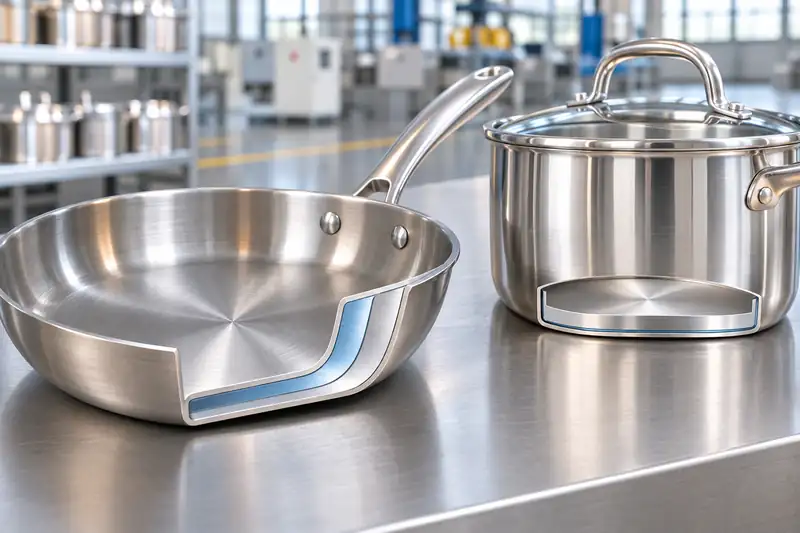
- 430 — a ferritic, nickel-free grade. Magnetic, so it is used as the outer layer of tri-ply cookware to make it induction compatible.
Where each grade makes sense
| Grade | Best use | Watch out for |
|---|---|---|
| 18/10 | Premium cookware interiors, mirror-polished serving pieces | Highest material cost |
| 304 (18/8) | Cookware, mixing bowls, GN pans, kettles, lunch boxes | Grade substitution by low-cost suppliers |
| 201 | Budget bowls, exterior parts, dry-use items | Pitting with salt, vinegar and dishwasher detergents |
| 430 | Induction outer layer, encapsulated bases | Lower corrosion resistance than 304 on food-contact faces |
A practical rule we use with private-label clients: anything that touches salty or acidic food for long periods — stock pots, mixing bowls used for marinades, steam-table pans — should be 304 or better. 201 is acceptable for short-contact items and for value programs where the buyer accepts the trade-off and labels accordingly.
Why the magnet test is unreliable
Austenitic grades are nominally non-magnetic, but cold working during deep drawing and spinning makes parts of a 304 pot slightly magnetic. Meanwhile some 201 is barely magnetic at all. A fridge magnet therefore cannot tell 304 from 201. Use these checks instead:
- Mill test certificates for the coil used in your production, matched to the order.
- Handheld XRF analysis on random samples during pre-shipment inspection — it reads chromium, nickel and manganese in seconds.
- Laser or stamped marking of the grade on the base, which makes substitution traceable.
- Salt-spray testing (for example 24–48 h neutral salt spray) when you need a performance benchmark rather than a chemistry check.
Food-contact compliance
Grade alone does not make a product compliant. EU buyers typically request LFGB or Regulation (EC) No 1935/2004 migration testing; US buyers rely on FDA food-contact requirements, often verified by third-party labs. Ask your supplier to test the finished article — including welds, rivets and coatings — rather than the raw coil.
How to write the grade into your purchase order
Specify the grade for every component separately (body, base disc, handle, rivets, lid rim), the thickness tolerance, and the verification method. A clear line such as “Body: SUS304, 0.6 mm ±0.03; base: 430 encapsulated; verified by XRF on AQL sample” removes ambiguity and gives your inspector something objective to check.
Frequently asked questions
Is 18/10 better than 304?
18/10 is a variant of 304 with higher nickel content. It is slightly more corrosion resistant and polishes brighter, so it is preferred for premium cookware, but 304 (18/8) is fully suitable for food contact.
Is 201 stainless steel safe for food?
201 can be used for food-contact items, but it resists corrosion less well than 304, especially with salt and acids. It is best reserved for short-contact or budget items, and finished products should still pass migration testing.
How can I tell 304 from 201?
Not with a magnet. Ask for mill certificates and check samples with a handheld XRF analyser, which measures nickel and manganese content directly.